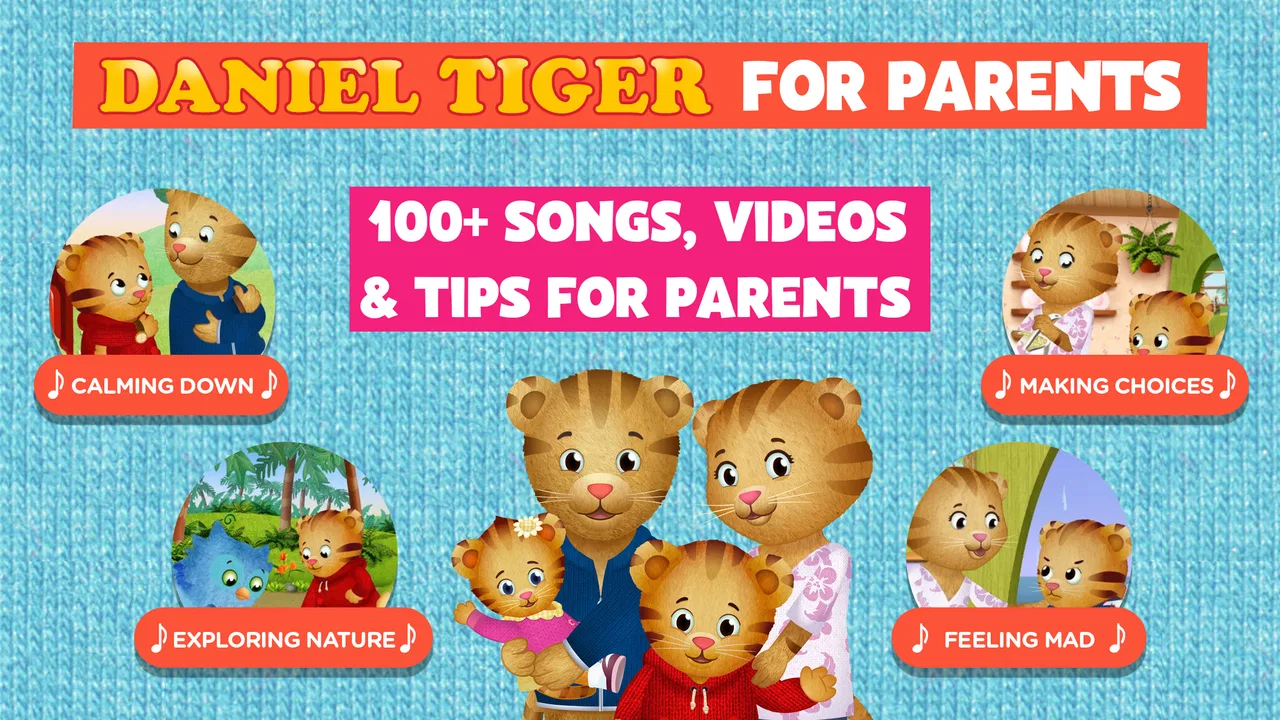
Daniel Tiger for Parents
- 3.7
- Rating
- 500.00K
- Installs
- Free
- Price

 Analysis by App-foxy
Daniel Tiger for Parents is the kind of parenting app I would reach for when a toddler needs help with a small but emotionally difficult moment: washing hands, getting dressed, waiting, sharing, calming down, or moving from one activity to another. It is not trying to be a complete parenting course, and it is not a replacement for conversation with a child. Its value is narrower and more practical: it gives familiar Daniel Tiger language and playful activities that can help turn everyday routines into teachable moments.
After spending time with it, my overall impression is positive but specific. This is best understood as a gentle routine-support tool for toddlers and their caregivers, not as an app children should explore alone for long periods. The connection to the Daniel Tiger character makes the lessons approachable, while the parent-focused design encourages an adult to stay nearby and connect what appears on the screen with what is happening in real life.
How Daniel Tiger for Parents works in everyday family life
The app comes from PBS KIDS, a developer with a clear focus on children’s learning, and it sits in the parenting category rather than presenting itself as a conventional game. That distinction matters. The goal is not to keep a child busy through endless levels or competition. Instead, the app uses Daniel Tiger as a familiar guide for life’s small lessons, giving parents a starting point for conversations that can otherwise feel repetitive or frustrating.
You May Also Like

 Blood Strike: 2.5 Anniversary
Blood Strike’s Loadouts Turn Every Drop Into a Tactical Gamble
A close look at Blood Strike’s custom loadouts: how fast access to signature weapons reshapes its battle royale rhythm, rewards preparation, and narrows the gap between fights.

 Pandora - Music & Podcasts
Pandora’s Music Is Easy to Start, but Harder to Recover
Pandora’s strength is its low-effort path from a seed to a station. Its weak spot is how much confidence it asks you to place in connection, setup, and quiet recovery.

 8 Ball Pool
 Is Built on Rivalries, Rematches, and Routine
A close look at the rivalries, rematches, shared routines, and unanswered safety questions that turn a quick pool match into a persistent mobile community.

 Samsung Music
’s Quiet Strength Is Playing What You Already Own
Its reach comes less from spectacle than from dependable access to a personal library. That simplicity is both the app’s strongest retention engine and its ceiling.

 AccuWeather: Weather Radar
AccuWeather Review: A Quick, Clear Forecast for Everyday Decisions
For everyday plans, the best forecast is the one you can understand quickly. AccuWeather makes rain timing, radar, and local conditions easy to act on, with a few trade-offs.

 Hill Climb Racing
Why Hill Climb Racing Still Turns Crashes Into One More Run
A tiny car, a bumpy hill and one more upgrade: Hill Climb Racing keeps resurfacing because its simple chaos makes every near-miss feel personal.
More From Our News Desk



I found the strongest use case was the transition between activities. Toddlers often understand what an adult is asking but still resist because stopping play, leaving home, or beginning bedtime feels abrupt. A short Daniel Tiger activity can create a shared pause before the transition. I would not use it as a bribe, such as promising screen time every time a child puts on shoes. It works better when the parent watches along, names the feeling, and then points back to the real task.
For example, imagine a child refusing to tidy up before dinner. Rather than handing over the phone and walking away, a parent can sit beside the child, use the relevant lesson as a conversation starter, and then make the next step very small: put away the blocks first, then choose the next activity. The app does not solve the resistance by itself. Its useful contribution is giving the adult a friendly character and a simple structure for explaining why the routine matters.
That parent participation is easy to underestimate. Many children’s apps are designed around independent tapping, quick rewards, and constant novelty. This one is more useful when the adult treats the screen as a prompt rather than a babysitter. I see that as a strength, although it also means the experience may feel less impressive to families looking for something that occupies a child without supervision.
Why the Daniel Tiger theme helps
For a toddler who already recognizes Daniel Tiger, the character creates immediate emotional familiarity. A lesson delivered through a known figure can feel less like an instruction from an adult and more like a shared story. That can be particularly helpful when a child is tired or defensive. The app’s tone is softer than a strict behavior chart, and that makes it easier to introduce ideas such as patience, cooperation, and emotional regulation without turning them into a lecture.
The character also gives parents a consistent vocabulary. If a family returns to the same phrases during play, meals, or getting ready to leave, the child may begin to recognize the pattern outside the app. I would not promise that this happens automatically, but the repeated connection between a familiar character and a real routine is more meaningful than a random animated distraction.
There is another practical advantage: the app can help adults who know what they want to teach but are unsure how to phrase it for a toddler. A parent may understand the importance of waiting, sharing, or calming down, yet struggle to explain those ideas at a two-year-old’s level. Daniel provides an accessible entry point. The adult can then adapt the message to the child’s age, temperament, and current situation.
What I would do before handing it to a child
My first recommendation is to explore the app without the child present. Parents should identify which activities match a current need instead of opening it during a crisis and hoping something useful appears. If mornings are difficult, preview the material before the next morning. If the problem is sharing, choose a calm moment to watch together rather than introducing the lesson in the middle of an argument over a toy.
This preparation also helps prevent the app from becoming an automatic response to every uncomfortable feeling. A toddler who is upset may need a hug, quiet, food, sleep, or a change of environment. The screen should not become the family’s universal calming button. I get better results when the app is used proactively, then followed by a real-world action that reinforces the lesson.
A second tip is to keep the follow-up concrete. After an activity about a routine, ask the child to demonstrate one small part of it. After discussing feelings, offer two simple choices rather than asking an abstract question such as, “Why are you angry?” This approach makes the app’s ideas usable. The content becomes a bridge to action instead of a pleasant but isolated viewing session.
A third tip is to use the child’s own interests to extend the lesson. If Daniel helps introduce a cleanup routine, let the child choose whether to start with books or toys. If the topic is waiting, practice with a very short turn-taking game. Giving the child a manageable choice preserves the lesson’s purpose while reducing the sense that the app is simply another adult command.
Strengths that matter more than flashy entertainment
The biggest strength is focus. Daniel Tiger for Parents is built around ordinary experiences that create disproportionate stress in family life. These are not dramatic problems, but they happen repeatedly, and small improvements can make a day feel much easier. The app is therefore more valuable to a parent facing the same struggle every morning than to someone searching for a broad educational platform with many unrelated subjects.
I also appreciate the emotional tone. The app does not make a toddler feel like a problem to be corrected. Using a recognizable character can soften the introduction of a new habit and give the parent a chance to acknowledge that the child’s feelings are real, even when the behavior still needs to change. That balance is important: understanding frustration does not mean allowing unsafe or disruptive behavior to continue.
Another strength is its suitability for shared use. Some toddler apps are visually busy and reward rapid interaction, which can make it difficult for an adult to turn the experience into a conversation. Here, the parent can pause mentally, ask what the child noticed, and relate the lesson to the family’s own routine. The best moments are not necessarily the ones where the child taps the most; they are the ones that lead to a useful exchange afterward.
The app is free, which removes a significant barrier for families who want to try it without committing money first. It is also rated for Everyone, making its intended audience broad from a content-rating perspective. I would still judge whether the material suits an individual child’s developmental stage and attention span, because an age label cannot account for every toddler’s needs.
The limitations parents should understand
The main limitation is that this is a support tool, not a guaranteed behavior solution. A child may enjoy Daniel Tiger and still refuse to brush teeth, leave the playground, or share a toy. That is not a failure of the app; it is simply the reality of toddler development. Parents expecting a single activity to end a recurring conflict may come away disappointed.
The parent-centered approach can also feel demanding when an adult is exhausted. To get the most from the app, someone needs to choose the right moment, watch with the child, explain the connection, and follow through away from the screen. During a rushed morning, that may be more effort than a family can manage. In those situations, a printed routine chart, a song sung together, or a consistent verbal cue may be faster and more effective.
There is a trade-off between familiarity and variety as well. Daniel Tiger is a strong fit for children who like the character or respond well to story-based guidance. A child who prefers open-ended creative play, vehicles, animals, or highly interactive problem-solving may lose interest quickly. Families wanting early literacy practice, number work, drawing tools, or a wider collection of educational subjects should look toward a broader learning app instead.
I would also avoid using it as background media. If the child is only watching while an adult completes chores, the parenting value is reduced. The app may still be pleasant, but the important transfer from screen lesson to real routine is less likely when nobody discusses it. This is the clearest difference between its intended role and that of a typical entertainment app.
Who will get the most from it
I think it is a particularly good match for parents of toddlers who already know Daniel Tiger and are working on predictable daily challenges. It can be useful during a period of change, such as starting a new childcare routine, welcoming a new sibling, or trying to make transitions less confrontational. The app gives the adult something concrete to introduce before the difficult moment arrives.
It may also suit caregivers who want a calm, character-led alternative to reward-heavy behavior systems. Some families do well with stickers and charts; others find that external rewards turn every routine into a negotiation. Daniel Tiger for Parents offers a more conversational route. It does not remove the need for boundaries, but it can help explain those boundaries in a way that feels warmer and more understandable to a young child.
Grandparents, babysitters, and other caregivers could use it as a shared reference point too. Consistency matters when several adults look after the same toddler. If everyone uses similar language around waiting, cleanup, or calming down, the child receives a clearer message. The app cannot coordinate a family by itself, but it can give different caregivers a common starting point.
I would recommend skipping it if you want a fully independent experience, a large game world, or a serious developmental curriculum with detailed progress tracking. It is also not the right answer for a child who is already overwhelmed by screens or for a family trying to reduce device use altogether. In those cases, the same ideas can be taught through books, pretend play, songs, and daily modeling without opening an app.
Device details and practical expectations
The app launched on February 1, 2017, and the current version is 2.0.0. It supports Android 7.0 or later, so families using an older device should check compatibility before planning around it. Its reach is substantial, with over half a million installs, while the average rating is 3.7 from around eight hundred ratings. Those figures suggest a useful but not universally loved experience, which matches my view: the app’s success depends heavily on whether a family wants guided parent-child activities rather than standalone entertainment.
Because it is free, trying it is relatively low-risk. I would still approach installation with a clear purpose. Decide whether you are testing it for bedtime transitions, emotional language, cooperation, or another specific routine. After several uses, ask whether the child is carrying anything from the activity into real life. If the answer is no, the problem may be timing, lack of follow-through, or simply a mismatch with the child’s interests.
The Everyone content rating makes it approachable for family use, but parents remain the best judges of context. A lesson that works beautifully for one toddler may be too simple for another or may need more explanation. The most effective use is flexible: keep the character’s friendly framing, but translate it into the words and routines your own household already understands.
My final recommendation
Daniel Tiger for Parents is worth trying when you want help turning familiar toddler struggles into short, shared learning moments. Its best quality is not technological sophistication. It is the way a recognizable character can make an ordinary routine easier to discuss, especially when a parent stays involved and follows the lesson with a real action.
I would recommend it to families who enjoy Daniel Tiger, need support with transitions or emotional skills, and are willing to use the app together. I would not recommend relying on it as a digital pacifier, a complete early-learning program, or a substitute for steady boundaries. For those needs, a different kind of app—or no app at all—may be better.
In my experience, the right expectation makes all the difference. Treat Daniel Tiger for Parents as a small tool in a larger parenting routine, not as a magic fix. Used that way, its free, approachable format and calm character-led lessons can earn a useful place in the family’s toolkit.
FAQs for Daniel Tiger for Parents
01What is Daniel Tiger for Parents, and who is it designed for?
Daniel Tiger for Parents is a family-focused companion app based on the Daniel Tiger’s Neighborhood television series. It is designed mainly for parents and caregivers of preschool children. The app offers practical tools, songs, short videos, and activity ideas that can help children understand everyday situations such as sharing, managing emotions, trying new routines, and handling transitions in a friendly, familiar format.
02What features are available in the Daniel Tiger for Parents app?
The app generally combines parenting guidance with child-friendly content inspired by Daniel Tiger’s Neighborhood. Depending on the version and device, parents may find videos, music, printable or interactive activities, routine suggestions, and advice for common preschool challenges. The content focuses on emotional development, social skills, independence, and daily habits rather than offering a traditional game or open-ended entertainment experience.
03Is Daniel Tiger for Parents suitable for toddlers and preschool children?
Yes, the app is primarily aimed at families with toddlers and preschool-aged children, although the exact recommended age can vary by feature. Younger children may enjoy the songs and familiar characters, while parents can use the activities and guidance to support conversations about feelings and behavior. Adult supervision is still recommended, especially when children are watching videos or using interactive sections.
04Does Daniel Tiger for Parents require an internet connection or include in-app purchases?
Some parts of Daniel Tiger for Parents may require an internet connection, particularly when streaming videos, loading new content, or accessing external resources. Availability of offline features and downloadable material can depend on the app version. Parents should also check the current store listing for subscription details, advertisements, or in-app purchases, since these policies and included content may change over time.
05Can Daniel Tiger for Parents help with emotional learning and daily routines?
The app is intended to support, rather than replace, real-world parenting and communication. Its songs, stories, and suggested activities can help children name emotions, practice calming strategies, and prepare for routines such as bedtime, cleanup, or going somewhere new. The most effective results usually come when parents use the app together with their child and reinforce the ideas during everyday situations.
Pros
- Age-appropriate activities based on Daniel Tiger’s Neighborhood
- Helpful tips support parents during everyday routines
- Simple interface makes the app easy for families to navigate
- Encourages emotional learning and positive social behavior
- Useful ideas for playtime
- transitions
- and family conversations
Cons
- Some content may feel repetitive after frequent use
- Best suited to families already familiar with the TV series
- Certain features or activities may require in-app purchases
- Limited appeal for children outside the preschool age range
- Requires supervision to turn app suggestions into real-life practice

Daniel Tiger for Parents
Gallery